

‘Brain drain,’ taxes, gaps in economic ‘inclusion’ among ‘uncomfortable truths’ business leaders say call for urgent response
Omaha, NE — A new “economic scorecard” ranks the Omaha metro area, anchored by Nebraska’s largest city, near the bottom of 23 metros nationwide that compete for jobs, talent and investment.
More specifically, the Omaha area placed No. 18 — sixth lowest of 23 peer metros from Boise to Kansas City and Pittsburgh — based on an examination of 50 data points across nine key economic-related categories.

The Greater Omaha Chamber of Commerce. (Courtesy of Greater Omaha Chamber)
Omaha’s rank is unchanged from last year but has slipped two spots since 2021 in the annual Barometer report produced for the past decade by the Greater Omaha Chamber of Commerce and University of Nebraska-Lincoln’s Bureau of Business Research.
Omaha’s overall score in 2025 is 4% below the national average. Released Monday, this year’s 32-page report led by UNL economist Eric Thompson said the findings shine “a light on uncomfortable truths” that must be confronted with “urgency.”
‘Brain drain’
The alarm is similar to one sounded in a separate report released this month by the Aksarben Foundation, a more than century-old statewide Nebraska business organization. That research, conducted by Development Counsellors International, showed seven comparison cities outside Nebraska growing jobs about five times faster than Omaha.
An Aksarben view
Nebraska’s two largest metro areas, Omaha and Lincoln, have lagged 68,000 jobs behind where both would have been had the markets kept pace the last five years with peers, according to the separate Aksarben Foundation report.
Peer markets for that research included Fayetteville, Arkansas, Huntsville, Alabama and Sioux Falls, South Dakota.
Those 68,000 occupied jobs would have generated an estimated $11 billion in additional wages, the report said, which could have resulted in $600 million to $800 million in additional tax revenue for the state.
— Cindy Gonzalez
The Lincoln market’s employment and wage growth were nearly identical to Omaha’s, Aksarben leaders said, adding that such “lack of performance” from Nebraska’s two biggest economies represents a potential loss of billions of dollars in wages that could have led to hundreds of millions in tax revenue for the State of Nebraska, which faces a hefty budget shortfall.
Both reports lament “brain drain,” the exodus of young educated talent from the state. The chamber calls the findings one of the “uncomfortable truths.” Aksarben says brain drain is “far more significant economically than simply an inconvenient truth.”
The chamber report says growth in the number of college graduates ages 25 to 34 is important to workforce strength, yet that population in the Omaha metro from 2019-2023 grew by 1.5% — slower than the national growth rate of 6%. By that measure, Omaha scored less than all 23 metros except Columbus, Ohio, and Pittsburgh.
A data-driven effort and survey last year by the chamber and University of Nebraska at Omaha spotlighted some key ways to stop the loss of young talent, including investing in more public transit options, better salaries and flexible scheduling. More than three-quarters of those surveyed described a workplace focus on diversity, equity and inclusion as a “good thing.”
For employment growth, a data point that reflects expansion of private and government job opportunities, the chamber report showed an Omaha growth rate of nearly 1.5% per year from 2021 through 2024 — slower than all its comparison metros except Milwaukee.
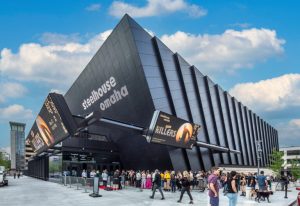
Steelhouse live entertainment venue, Omaha Performing Arts’ third major facility downtown in Nebraska’s biggest city, opened this year, bringing jobs and business to the area. (Courtesy of Tom Kessler)
“We are not growing our workforce fast enough. We are not retaining enough of our college graduates. We are not adding jobs or raising private sector wages at the pace needed to stay competitive,” the report stated.
Researchers said high taxes and educational attainment gaps are a further drag on the economic outlook of the eight-county Omaha metro area that recently surpassed the million-person mark.
The report noted that sales and income tax rates influence human capital development, as workers will invest more at work and in education if they expect to keep more of the earnings those investments generate. Of the metros the study included, Omaha ranked above only Greenville, S.C., and Buffalo N.Y., for sales and income tax rates, and its position has slipped over the last few years.
“The stark reality is that Greater Omaha must grow faster — faster in employment, faster in wages, faster in residents,” Heath Mello, chamber president and CEO, said in a statement to the Nebraska Examiner.
Highs and lows
Thompson said the latest economic report card also points out “numerous strengths including higher education attainment, labor force participation and the quality of life” in the Omaha area.
In developing the report, his team looked at nine general areas and drilled down into 50 data points. The chamber says the results help gauge how the Omaha area stacks up against other metros jockeying for position in a “race for the future.”
Omaha’s progress has been outpaced by high-performing comparison metros, the chamber said. Denver, Nashville, Austin, Salt Lake City and Raleigh have held the highest rankings over the past four years.
Of the nine general areas, Omaha’s highest marks came in quality of life (ranked 8th), innovation (11th) and entrepreneurship (11th).
Driven by arts and cultural opportunities and quick commute times, Omaha maintained its No. 8 ranking in the quality of life category. Fun fact: Omaha’s average commute is 20.9 minutes, almost six minutes faster than the national average, the report said.
The report comes as Omaha has tried to spice up its allure, with multimillion dollar developments, including the modern-day streetcar project poised to run from downtown to midtown, the overhaul of downtown parks and amenities as “The RiverFront,” continued growth of the University of Nebraska Medical Center campus and other redevelopment sites across the metro.
Omaha improved its showing in the entrepreneurship category, jumping to No. 11 from last year’s No. 14. On average, the report said, Omaha-area entrepreneurs earn more than those in other metros.
Steelhouse live entertainment venue, Omaha Performing Arts’ third major facility downtown in Nebraska’s biggest city, opened this year, bringing jobs and business to the area. (Courtesy of Tom Kessler)
“We are outpacing these metros and the nation at large in GDP growth, keeping down industrial energy costs and demonstrating strong outcomes in unemployment, poverty reduction and closing the gender earnings gap,” the report said.
However, some of Omaha’’s lowest scores showed up in “human capital” — an area researchers described as critical to growth that reflects educational and occupational skills of the workforce.
Human capital is the area that captures the lag in growth of college graduates and income and sales tax burdens relative to other metros. Omaha placed 20th in the human capital category — a fall from 17th four years ago.
The Omaha chamber, which represents nearly 3,000 member companies, including businesses of all sizes, expects the report to inform employers and policy-makers about where dollars and focus should go.
Moving forward, the Omaha chamber said it plans a focus on three areas: growing and retaining talent, accelerating business growth and positioning the Omaha area “more boldly” on the national stage.
That means investing in “groundbreaking research” to understand why brain drain is happening and how to address why young educated talent is leaving, the chamber said in the report.
Business leaders said they also also want more economic development tools and incentives to compete for new-to-market companies and to help employers expand operations.
“From City Hall to the State Capitol to Washington D.C., economic development and workforce policy must be top of mind for our elected officials,” the report said.
Inclusivity to innovation
Among other score card highlights: For inclusivity, the Omaha area’s score reflects several data points that placed it at No. 13 among the 23 metros. An inclusive economy was described as one in which a broad-section of the population participates in prosperity.
While the Omaha area outperformed the nation for its low poverty rate — the U.S. rate reportedly is 31% higher — the area ranked No. 16 among the 23 metros for the poverty rate gap, indicating that the poverty rate is relatively high for the Omaha area’s non-white and Latino populations.
Also related to inclusivity, the Omaha area ranked 18th of the 23 metros in its educational attainment gap, indicating that education attainment is comparatively low in Omaha for non-whites and Hispanics.
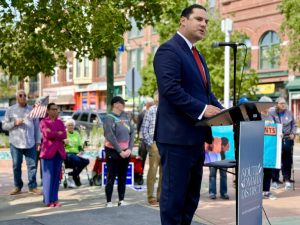
Heath Mello, president and CEO of the Greater Omaha Chamber addresses a rally at la Plaza de la Raza in South Omaha. (Cindy Gonzalez/Nebraska Examiner)
For innovation, which relates to development of new technologies that can spur high-value entrepreneurial ventures, Omaha has sustained the rank of No. 11 for the past two years. The report said the information technology industry makes up 3.4% of the Omaha area’s economy, higher than the national average of 2.9%.
In the “cost of doing business” category, Omaha climbed from No. 17 last year to No. 15. The report said the Omaha metro consistently has lower business costs due to its lower industrial energy costs and wage rates.
The Omaha area’s average wage rate for occupations examined in the report was 13% below the national average.
Mello said a community effort is needed to tackle weaknesses and harness strengths.
Omaha Mayor John Ewing Jr., in a statement Monday, said he believes Omaha’s moment is now.
“So much movement is happening in improving amenities and the quality of life. We just all need hands on deck to come together to create a comprehensive and collaborative plan to retain the companies we have, retain the human capital we have and create an environment where our residents and businesses thrive.”
Said the report: “If this Barometer (report) offers a tough diagnosis, it also points us toward our plan for the future.”
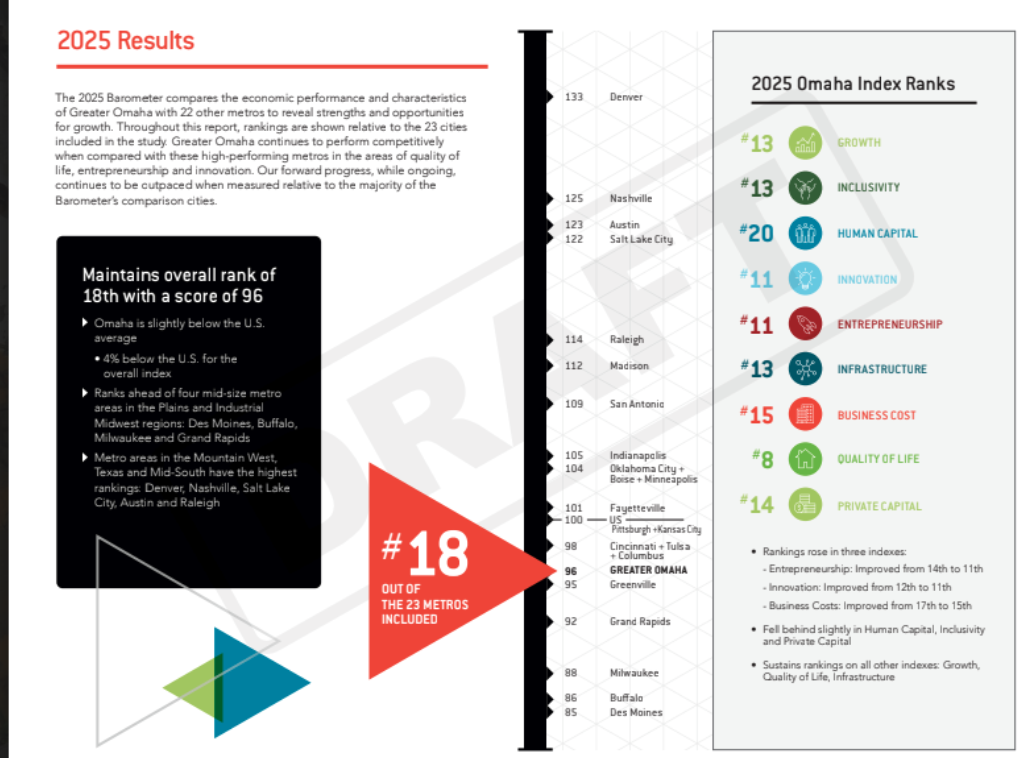
Greater Omaha Chamber’s 2025 economic scorecard ranked the Omaha metro No. 18 of 23 metros. (Courtesy of Chamber)
Stay informed about what’s happening in your community. Your source for stories that inspire — visit HolaNebraska.org for news, culture, and community updates across Nebraska!