
Photo illustration by Hanscom Park Studio. Photos by Eric Gregory for the Flatwater Free Press
By Emily Wolf, Flatwater Press
In the past year, all new Nebraska refugees have come from one country: South Africa. The near-freeze has drained funding for resettlement agencies and upended the lives of the people they’re meant to serve.
Der Yang knew there wasn’t much time.
It was fall 2024, with a possible second term for President Donald Trump on the horizon. During his first term, Trump sought to ban Syrian refugees, paused resettlement entirely for months and set a record-low cap on the number of refugees allowed into the country.
Yang and her team at the Center for Immigrant and Refugee Advancement (CIRA) didn’t wait to find out what was coming next. Instead, they got to work resettling as many refugees as they could before Trump’s inauguration. Long hours at the office stretched even longer, and drives to the airport became more frequent. Staff rushed to secure housing for newcomers and make sure it was furnished.
From that October to January, the organization welcomed 233 people in Omaha and another 70 in Lincoln.
They haven’t resettled anyone since.
The Trump administration’s freeze on refugee resettlement at the end of January 2025 started a domino effect throughout the country. Vetted refugees, days away from entering the U.S., had their flights canceled overnight. Funding to support newly arrived refugees was suspended. Layoffs began at resettlement agencies, then programs closed altogether.
In the year since, what was once a robust refugee resettlement landscape in Nebraska has become a shadow of its former self. Of four resettlement agencies in the state, only one, Lutheran Family Services, is actively resettling refugees. Newcomers number in the dozens. And this year, all new Nebraska refugees have come from one country: South Africa.
It’s a dramatic change for the Cornhusker state, which in previous years accepted thousands of refugees from dozens of countries, including Afghanistan, Myanmar and South Sudan. Those same refugees are now facing empty pantries and financial hardship amid increasing eligibility restrictions for programs like SNAP and Medicaid. Resettlement agencies are relying more heavily on private funds to help meet those emerging needs, all while navigating a constantly shifting legal landscape.
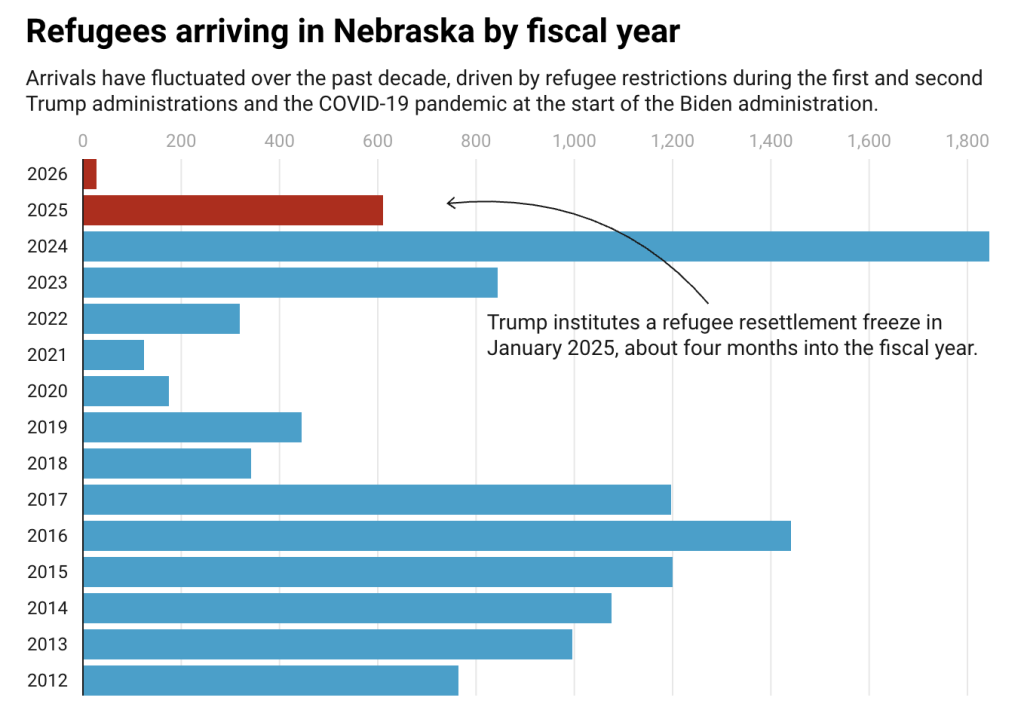
iscal year 2026 data is from Feb. 28, 2026.
Source: U.S. Department of State | Bureau of Population, Refugees, and MigrationCreated with Datawrapper
Refugees arriving in Nebraska by fiscal year
Arrivals have fluctuated over the past decade, driven by refugee restrictions during the first and second Trump administrations and the COVID-19 pandemic at the start of the Biden administration.
“It’s almost like pulling the rug from underneath them,” said Yang, CIRA’s director of refugee services. “When we agreed to resettle them, we had promised them safety. They were leaving war-torn countries and really unsafe places … Now, with all the policy changes, they’re going to be without food. They’re going to be without health insurance. There’s even talk about them being without housing.”
The Trump administration has said the freeze is necessary to stem increasing migration to the U.S. In his executive order, Trump wrote that the U.S. doesn’t have the ability to welcome large numbers of refugees into its communities “in a manner that does not compromise the availability of resources for Americans, that protects their safety and security, and that ensures the appropriate assimilation of refugees.”
But for Nebraska’s refugee communities, the federal changes feel alienating. Assimilation has become daunting, particularly because some refugees already in the state have been unable to reunite with their loved ones overseas since the freeze took effect.
“Refugees want to be here,” Yang said. “They have accepted that this is home. So the policy changes and the current political climate that we live in makes them feel unwelcome and unsafe. As people and as an agency that welcomed them here, these policy changes go against everything that we have stood for.”
Two years ago, Nebraska’s resettlement agencies had a clear focus.
Staff were the first to greet refugees when they stepped off the plane and helped get them settled into apartments. They tried to teach newcomers how to use the U.S. banking system and how to catch a bus. They signed them up for ESL classes and helped them find job opportunities.
“We’re helping families apply for public benefits such as SNAP and Medicaid and any cash assistance,” Yang said. “We’re making sure that they are getting the health screenings that they need. We’re enrolling children in school.”
The funding for these early efforts — generally restricted to the first 90 days — came from the federal Reception and Placement program. Agencies received one-time payments for each refugee they took on. Getting newcomers self-sufficient quickly was the priority, said Poe Dee, director of refugee and immigrant services at Catholic Social Services of Southern Nebraska.
“When refugees come, they know that they’re not going to rely on government benefits forever — they know that they have to work,” Dee said.
Who is a refugee?
Under U.S. law, a refugee is someone who is unable or unwilling to return to their home country because of demonstrable persecution or fear of persecution due to race, religion, nationality, political opinion or membership in a specific social group. They are of special humanitarian concern to the U.S., and are located outside of the country. They must be admissible to the U.S., and not firmly resettled in another country.
In fiscal year 2024, Nebraska resettled the most refugees per capita of any state, according to the Office of Homeland Security Statistics. That year wasn’t an outlier; Nebraska welcomed the most refugees per capita over a 10-year span starting in 2013, according to an analysis by the nonprofit Immigration Research Initiative.
But after Trump’s inauguration, the agencies’ resettlement work came to a screeching halt. For months, Nebraska didn’t resettle any new refugees, according to federal data.
Days after the resettlement freeze, the federal government suspended funding for support services for newly arrived refugees. The agencies had to shoulder the costs themselves or simply stop offering them while in limbo.
“Thousands and thousands of people were left under the care of entities that were actually operating on fumes,” said Dekow Sagar, CEO and founder of Omaha-based International Council for Refugees and Immigrants. “I think that was the most shocking part for me. I knew (Trump) would probably freeze resettlement … but I thought the refugees that they already brought here, they’d make sure that they got (resources).”

Client Erika Abrahan (center) speaks with Director of Refugee and Immigration Services Poe Dee (left) and Immigration Specialist Monica Suarez at Catholic Social Services of Southern Nebraska. Before the federal government froze funding, CSS was able to offer services like green card application help for free. Photo by Eric Gregory for the Flatwater Free Press
Chris Tonniges, president and CEO of Lutheran Family Services, ran through scenarios with his staff before the freeze hit. They’d seen cuts to the refugee program during Trump’s first term and were braced for similar reductions in his second. While the organization was budgeting to accept 1,600 refugees, Tonniges knew the chances of that being pared back were high. But no one expected a complete shutdown.
“We were nowhere even (close to being) prepared to be in the position we ended up in in January,” Tonniges said.
In March 2025, LFS laid off 13 employees as a result of the freeze. The organization cut 60 positions, Tonniges said, though they were able to reassign many employees.
The International Council for Refugees and Immigrants, which started resettling refugees in 2024, had to lay off six employees and make several full-time staff members part time, said Samira Sarwary, ICRI’s finance manager. The organization now has 27 full-time employees. Sagar, the organization’s CEO, is unsure if that number is sustainable.
Sarwary said ICRI lost almost $825,000 as a result of the freeze — about 25% of its total budget.
Erik Omar, executive director of CIRA, said the organization lost roughly $5 million, including funds lost because of the resettlement freeze and subsequent funds lost as a result of closing four programs designed specifically for newly arrived refugees.
Agencies have relied more on private contracts and philanthropy to maintain refugee support services over the past year. Private dollars have made it possible for CIRA to build a new program aimed at helping meet refugees’ longer-term needs, Yang said. Private funding means they have a greater ability to pivot and change services as needed, she added.
“However, funding is limited, and so we can’t make up for a federal program that has been taken away,” Yang said, “but we’re really trying our best.”
Sebit Deng smiled and gestured to the small, quiet boy sitting beside him at the Catholic Social Services of Southern Nebraska conference room table.
“He is not my son,” Deng said.
It was late February, and Deng was looking after the child while his mother, a South Sudanese refugee, went to apply for her driver’s license. She hoped a license would open up new job opportunities, Deng said. After losing SNAP benefits, her current pay stopped being enough to cover her family’s expenses.
“Her children, she doesn’t want them to be stressed,” Deng said. “So that’s why now she is fighting to try to help herself, and we’ll try to help her.”
As a member of Catholic Social Services’ immigration legal services team and a former South Sudanese refugee himself, Deng knows refugee assistance takes many shapes. Sometimes, it’s child care. Other times, it’s helping someone apply for housing assistance or find a new job. More and more, it’s making sure people have food in their bellies.
It also has become a game of misinformation whack-a-mole as fears and rumors spread through refugee communities.
“You see things on TV, you hear things on the radio,” said Katie Patrick, executive director of Catholic Social Services of Southern Nebraska. “You heard from a friend, from a friend of a friend. As much as we can be a reliable source of information, it’s very important, because we don’t want people making choices or reacting to hearsay.”
Separating fact from fiction has been complicated by constant changes to federal immigration policy. In January, ICE’s detention of Minnesotan refugees for reverification was quickly challenged in court. By February, DHS issued a new memo authorizing the detention of refugees who haven’t applied for a green card within one year of arriving in the U.S. A federal judge in Massachusetts has since temporarily blocked the policy from being enforced.
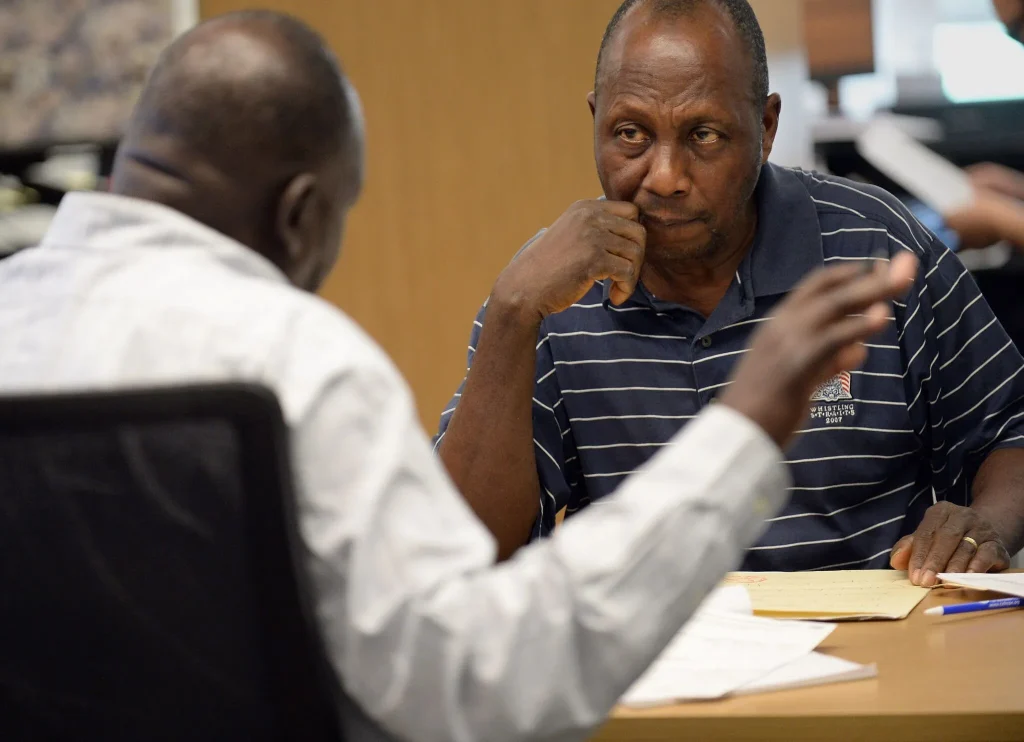
Frank Pittman (right) works with Immigration Specialist Sebit Deng at Catholic Social Services of Southern Nebraska as he navigates the process to bring his wife to the United States. CSS is not currently resettling refugees, but still supports refugees already in Nebraska. Photo by Eric Gregory for the Flatwater Free Press
While advocates say they’re not aware of any Nebraska refugees being detained under the memo, they’re not waiting for an arrest to start informing families. In March, CIRA hosted know-your-rights-trainings to help refugees understand what the memo means for them. Among the suggestions: If an eligible refugee hasn’t yet applied for a green card, they should consult with an attorney about starting the process.
“Legal permanent resident status is always going to be more secure,” said Alex Araya, an attorney with CIRA.
On a Thursday afternoon in March, Erika Abrahan stepped into the CSS office to take that next step. The Venezuelan refugee arrived in Nebraska in January 2025 and had been working with CSS’ immigration team to get the green card application process started. Now, she was back to pay CSS an administrative fee for their assistance.
Before the federal cuts, Dee said, CSS could offer green card application help for free. Now, fees are necessary to cover the team’s expenses. It costs $315 for an adult, $210 for a minor and half off for clients who qualify for low-income assistance.
“Now we have to charge them to make the program run,” Dee said. “It’s hard. You know their situation, you know their income status, but it is what it is, and you just have to do what is best for the program, for everyone.”

Client Frank Pittman (right) reacts with joy after being told he meets the income level required by the federal government to bring his wife to America. He was meeting with Immigration Specialist Sebit Deng at Catholic Social Services of Southern Nebraska. Photo by Eric Gregory for the Flatwater Free Press
Across the room, Deng greeted Frank Pittman, a Liberian man who came to the U.S. as a refugee in 2004. Now a naturalized citizen, he made an appointment with CSS hoping to submit a petition to bring his new wife and her children to the U.S. as well.
As the appointment came to a close, Deng jotted down a list of documents to bring to the next meeting and showed Pittman out. Then the immigration specialist made his way back to his desk and shared a sobering update: the South Sudanese mother from the month before hadn’t secured her driver’s license.
The U.S. refugee program has remained largely dormant since January 2025. But one group — white South Africans — was granted an exemption and prioritized for resettlement by Trump. The president has amplified false claims that white South African farmers are experiencing genocide, and has accused the South African government of subjecting them to racial discrimination.
Since May 2025, more than 3,000 white South Africans, known as Afrikaners, have entered the country as refugees.
As of mid-March, 41 South Africans had been resettled in Nebraska by Lutheran Family Services, the only organization actively accepting refugees in Nebraska. Last year was the first year Nebraska resettled refugees from South Africa.
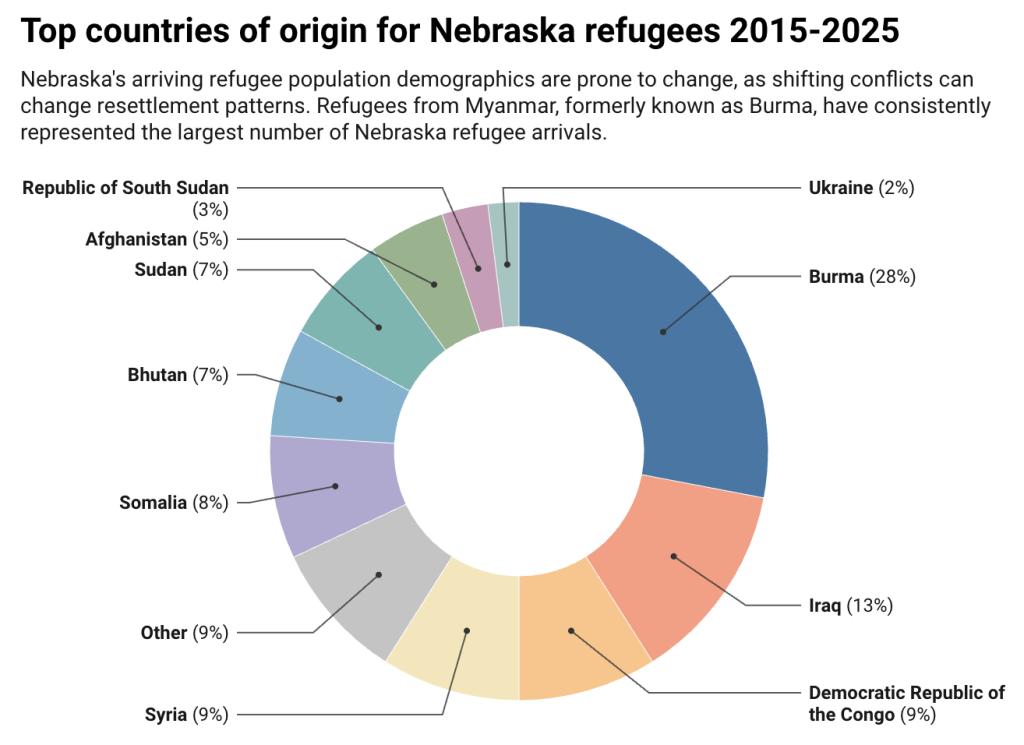
Source: U.S. Department of State | Bureau of Population, Refugees, and MigrationGet the dataCreated with Datawrapper
Top countries of origin for Nebraska refugees 2015-2025
Nebraska’s arriving refugee population demographics are prone to change, as shifting conflicts can change resettlement patterns. Refugees from Myanmar, formerly known as Burma, have consistently represented the largest number of Nebraska refugee arrivals.
While LFS has continued its resettlement program on a smaller scale, the federal government’s decision to prioritize one group for resettlement was a deciding factor for two Nebraska organizations no longer resettling refugees.
Yang, the director of refugee services at CIRA, said the organization had internal discussions before reaching that decision. If resettlement remained open to everyone, especially those already screened and approved to come to the U.S., they would continue doing the work.
“But because that isn’t the case, currently, we have decided we’re not going to resettle,” she said. “If it were to open up again where it’s for every population to come, I think that it’s definitely a possibility for us. But until that happens, I think we are really focused on serving the refugees that are currently here in Omaha and Lincoln.”
For Sagar, who came to the U.S. as a Somali refugee, resettling South Africans presented a moral dilemma. He spent his formative years in a refugee camp in Kenya and founded ICRI after realizing there was a shortage of long-term support resources for refugees. It has grown to offer youth programming, business development and mental health services for new arrivals.
He recalled his own entry to the U.S. in 2007 under then-President George W. Bush and how being Somali, Muslim and Black didn’t hinder his ability to resettle and begin a new life helping others. Limiting the resettlement program to South Africans frustrates him.
“I don’t think they really meet the criteria of a refugee,” Sagar said. “I think it would be morally wrong for me to say we’re working with people who might be coming here for other reasons, because I think it kind of undermines the plight of people who are actually facing an actual prosecution or fleeing conflict or genocide or systematic oppression.”
For Catholic Social Services, the decision to continue resettling refugees was taken out of their hands. The organization’s national affiliate, the United States Conference of Catholic Bishops, announced it would end its refugee resettlement contract with the federal government last April.
“A 40-year relationship has ended,” said Patrick, executive director of CSS. “It’s a heartbreak.”
Patrick doesn’t anticipate the Conference of Catholic Bishops resuming its role as a resettlement organization. But if resettlement shifts to a different model, Patrick said CSS would be happy to participate in resettlement activities again.
Tonniges of Lutheran Family Services said the closure of CSS’ resettlement program has downstream effects on his organization. Staff used to walk individuals back and forth between the two offices in Lincoln, making sure they had access to as many resources as possible, he said.
“It’s a loss for the community and it’s a loss for us, because there was this real sort of symbiotic relationship … we sort of rely on each other to fill gaps, in real partnership with one another,” he said.
The future of refugee resettlement in Nebraska is unclear. This fiscal year, the Trump administration set another record-low refugee admissions cap of 7,500 — and announced plans to continue prioritizing Afrikaners.
Advocates predict future administrations will work to restore the resettlement program. But with three of four agencies in the state having stopped resettlement, it’s hard to tell how many will be in a position to resume three years from now.
“I think rebuilding the infrastructure is going to take a long time, because everything has been demolished,” said Sagar, the ICRI director. “…Will we be able to actually join that again? I hope so, but I think it’s gonna be quite some time.”
Stay informed about what’s happening in your community. Your source for stories that inspire — visit HolaNebraska.org for news, culture, and community updates across Nebraska!