
By Hola Nebraska
As Nebraska works to expand broadband access, rural providers say stable internet remains important for school, farming, health care, small businesses and communication during severe weather.
Reliable internet remains uneven in parts of rural Nebraska, where the type of connection available can vary by location and technology.
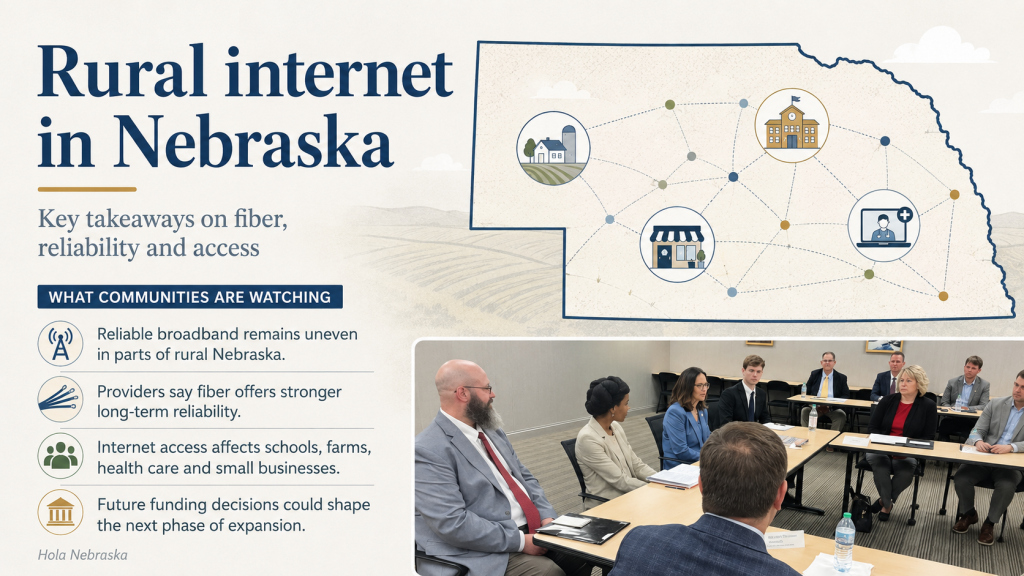
That issue was part of a broadband roundtable this week led by U.S. Sen. Deb Fischer, R-Neb., with Olivia Trusty of the Federal Communications Commission, local telecommunications officials and members of the Nebraska Public Service Commission.
The discussion focused on rural broadband, fiber connections and how Nebraska should use federal funding tied to the Broadband Equity, Access and Deployment Program, known as BEAD. The program is designed to help states reach homes, businesses and community sites that still lack reliable high-speed internet.
Rural providers say stable service matters as much as speed
Several rural telecommunications providers said fiber remains one of the strongest long-term options for many Nebraska communities.
Fischer said satellite, fixed wireless and other technologies can help expand service in some areas. She also said she is not convinced those options can meet the needs of every part of the state.
Providers at the roundtable pointed to reliability during severe weather. Fiber lines are often buried underground, which can help protect service during storms, tornadoes, wildfires and other emergencies.
John Nelson, CEO of Hamilton Telecommunications, and Nick Paden, vice president of Stanton Telecom, said some communities maintained internet service during Nebraska wildfires and tornadoes because fiber connections were already in place.
For rural families, reliable service can affect more than streaming or basic browsing. Students may need broadband for homework and school portals. Older adults may use it for telehealth or benefits. Farmers may depend on connected systems for weather data, equipment, markets and operations.
Nebraska is weighing fiber and other broadband options
Gov. Jim Pillen created the Nebraska Broadband Office in 2023 to oversee the state’s implementation of BEAD. The office was created to manage the federal program while easing the workload of the Nebraska Public Service Commission.
Earlier this month, state officials celebrated Nebraska’s first BEAD-supported internet connection in Ogallala. That connection used fixed wireless technology.
Some roundtable participants raised questions about that approach. Public Service Commissioner Kevin Stocker said he was concerned about investing program money in areas that already had other ways to access internet service, including cellular technology.
The discussion reflects a larger decision for Nebraska: how to balance faster deployment through different technologies with longer-term fiber infrastructure that can be more expensive to build but may offer stronger durability over time.
Lee más: Omaha basketball players return home to mentor young athletes
Smaller communities face higher broadband costs
Nebraska was initially awarded $405 million under BEAD. After federal changes and a restructuring of the program, Pillen announced that the state applied for about $44 million for broadband expansion efforts.
That change reduced the size of Nebraska’s broadband plans and increased pressure on how the available money should be used.
John Barrett, vice president of government affairs for Great Plains Communications, said rural providers still need ongoing support. He said BEAD may help bring some level of service to more Americans, but low population density can make rural broadband investment difficult to sustain without continued state and federal help.
In many rural communities, providers must build and maintain service across long distances between homes, farms, roads and businesses. That raises the cost per customer and can make upgrades harder to finance.
For residents, the result can be uneven access. A connection that works well in one area may not be available a few miles away, especially in places where fewer customers are spread across larger distances.
Nebraska ranks low in BEAD funding for fiber
Participants also discussed how much of Nebraska’s BEAD funding is directed toward fiber. According to National Telecommunications and Information Administration data cited during the roundtable, Nebraska ranks last nationally in the percentage of BEAD funds going to fiber, at about 9%. The national average is about 62%.
Pillen has defended a broader broadband strategy. He has said treating fiber as the main standard ignores advances in other technologies, including satellite, cable and fixed wireless.
Rural providers at the roundtable emphasized the long-term value of fiber. Public Service Commissioner Tim Schram said the commission sees no substitute for fiber. According to information discussed at the roundtable, the Public Service Commission has connected about 46,000 locations to internet service through fiber.
The choice of technology can shape what kind of service rural communities rely on for years, especially in areas where new infrastructure may not be replaced quickly.
Broadband affects farms, schools and health care
The Nebraska Broadband Office says BEAD is intended to connect unserved and underserved locations, strengthen economic growth, support precision agriculture and help ensure reliable, affordable broadband access across the state.
Those goals connect directly to rural life in Nebraska.
Precision agriculture can depend on reliable data and connected systems. Schools use online platforms for assignments, grades and communication. Health care providers increasingly rely on portals, virtual visits and digital records.
Small businesses also need stable internet for payments, orders, customer communication and bookkeeping. For families, a dropped or slow connection can interfere with job applications, medical appointments, benefit forms and other basic services that now often require online access.
Fischer compared fiber investment to roads and waterways: infrastructure that can be costly to build, but is intended to serve communities for years.
Remaining BEAD funds could shape the next phase for rural internet
Fischer said she is still pressing federal officials to secure more than $300 million in remaining BEAD funds for Nebraska. Those funds have been described as non-deployment funds, and the National Telecommunications and Information Administration has not yet issued final guidance on how they can be used.
Fischer said she has spoken with Arielle Roth, U.S. Assistant Secretary of Commerce for Communications and Information, about the remaining money.
The Nebraska Broadband Office said in a written statement cited by Nebraska Examiner that the funds could be used for any purpose the assistant secretary determines is necessary to support BEAD’s goals.
The next step depends on federal guidance and state decisions about which technologies Nebraska will prioritize. For rural communities, the question is practical: what kind of connection can best support work, school, agriculture, health care and daily communication in the years ahead.
Stay informed about what’s happening in your community. Your source for stories that inspire — visit HolaNebraska.org for news, culture, and community updates across Nebraska!