
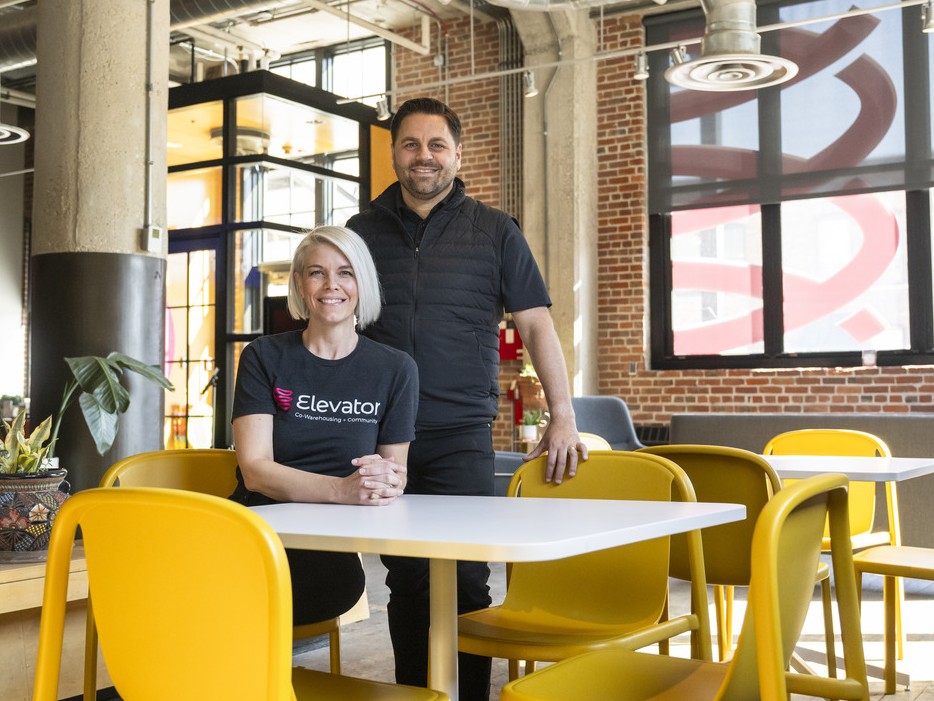
Shannon and Emiliano Lerda are the co-founders and owners of Elevator, which provides co-warehousing and co-working spaces in five Midwest cities. (Josh Peterson)
By Jonathan Turner, Hola Nebraska
Things are looking up for Shannon and Emiliano Lerda.
The Omaha-based husband-and-wife team owns Elevator, a company that provides co-warehousing and co-working spaces, to help businesses grow. They have locations in Omaha and Lincoln, Neb., Des Moines, north Kansas City, Mo., and their latest, in St. Louis, which opened recently. The Lerdas have plans to grow nationwide.
“St. Louis is going very well. We’re very excited,” Emiliano Lerda, company CEO, said recently. “There’s been a great early attraction with sales and also activity in the building. And we’re excited to see that. It just opened on March 1st, and we’re already seeing a lot of interest from the community.”
Blocks away from the Saint Louis Science Center and spanning 67,300 square feet, the new Elevator facility marks the company’s second Missouri location and fifth overall, continuing its Midwest expansion and its mission to elevate small businesses and communities through flexible workspaces, logistics support, and collaborative community environments.

Clients of Elevator on the roof of the company’s first location in downtown Omaha, Neb. (Josh Peterson)
The St. Louis facility integrates micro-warehouses, private offices, and shared amenities under one roof. It includes 8 dock doors, 118 parking spaces, 84 flexible warehouse units, 56 private office suites, coworking areas, conference and meeting rooms, event space, photo and video equipment, and daily carrier pickups from UPS, FedEx, and USPS.
“Having run an e-commerce brand ourselves, we know the challenges of growing a business from home and making constant trips to the post office,” said Shannon Lerda, president and co-founder of Elevator. “Elevator gives small business owners the flexibility, amenities, and the community we wished we had. We’re thrilled to finally be here and to start supporting the founders in St. Louis who have been waiting for this.”
While co-working spaces are common nationally (including artist studios together in Omaha), co-warehousing is unique to each of Elevator’s markets, Emiliano said.

Elevator CEO Emiliano Lerda is a 45-year-old Argentina native, who graduated from University of Northern Iowa. (Josh Peterson)
They were inspired to launch by their own home-based business selling pet products online in Omaha, and they were growing by 2019.
“We felt like we were ready to take the next step to grow that business and we decided we needed more space. Because to grow that business, we will have to process more volume,” Lerda said. “We were already receiving 15 boxes two to three times a week in our house. And we started using our spare bedroom and then our living room and then our garage and our basement. And we ran out of space and we went out looking for a small warehouse with access to a dock. And it was hard to find.”
They couldn’t find anything less than 5,000 square feet, most places wanted a commitment between three and five years, and they couldn’t just use a storage unit, he said. “It was Shannon that one day said, I love the sense of community and the networking that co-working offers.”
Shannon came up with the co-warehousing concept and “it kind of really struck a chord with me,” Emiliano said, noting they found a similar company doing it in Atlanta, that was thriving.
“We thought, maybe there’s an opportunity for us to start doing that in the Midwest and going to cities where the big players may be focusing on the big cities, but we have an opportunity to be first to market in these medium sized cities,” he said. “And so we started going after this dream and this idea.”
In October 2022, Shannon and Emiliano opened Elevator in Omaha’s Old Market district. The four-story building includes 104 spaces that range in size from 80 square feet to 1,500 square feet. The adaptable spaces are primarily for small-business owners who want flexible, logistics-focused work environments.
The Omaha location repurposed a historic downtown building — once home to O’Keefe Elevator — and transformed it into a multi-level hub for entrepreneurs, with warehouse units, private offices, coworking space, meeting rooms, loading docks, and business amenities under one roof.
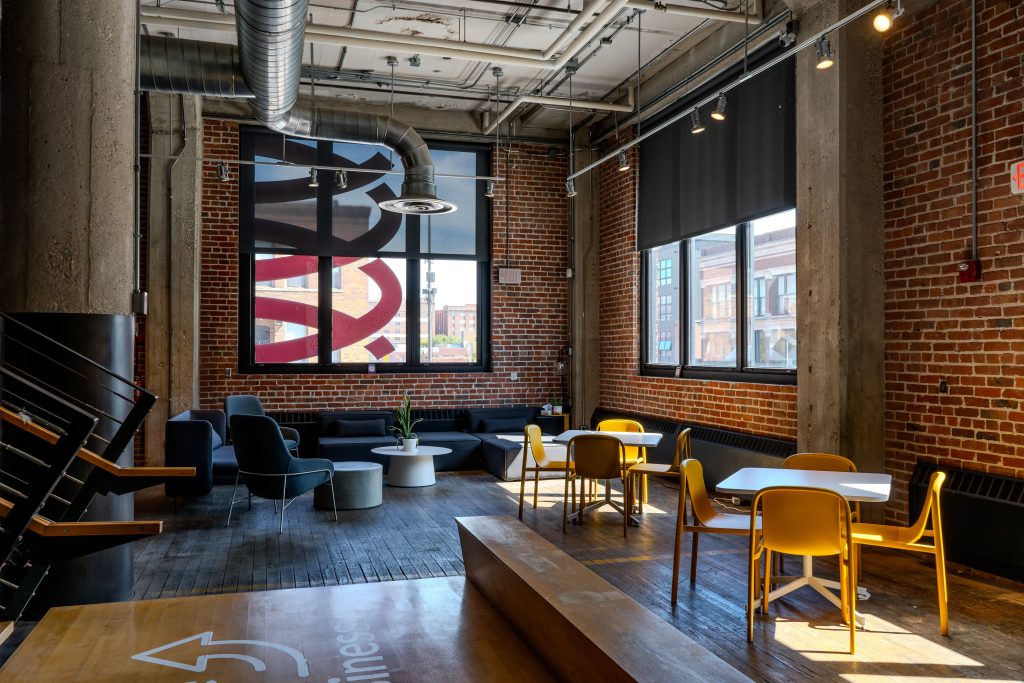
The lobby area of Elevator’s Omaha location. (Josh Peterson)
Shannon brings a background in finance and commercial real estate lending, giving her an understanding of how infrastructure can support business success. Emiliano’s roots in law, nonprofit leadership, and real estate investment and development made him a strategic leader, committed to creating community-driven spaces that provide value to investors and fuel economic mobility. The company name has symbolic meaning for clients.
“We help them go to the next level; we elevate them,” Emiliano said. “We thought calling the business Elevator would be tied to the roots of our first building, and the word is very symbolic of what we do — give businesses a lift.”
They also have strong ties to the Des Moines area. Shannon graduated from the University of Northern Iowa, and worked at Principal Global Investors in Des Moines for six years. Emiliano, a 45-year-old Argentina native, graduated from UNI and Drake University’s Law School. He worked for the Iowa Corn Growers Association for over year before relocating to Omaha to lead the Immigrant Legal Center, eight years as executive director. He also has been in leadership roles at Paul G. Smith Associates in Omaha, a development and investment firm.
He learned lessons from his time leading Immigrant Legal Center (which grew and moved to a new headquarters), and PGSA.
“I learned a lot of leadership lessons and how to build and grow a team and how to build process and the importance of operating processes and systems to build sustainable organizations,” he said. “So all of that helped me, essentially is helping me now.”
“We liked the proof of concept that we had built here in Omaha and we started looking for expansion opportunities,” he said, noting they wanted to stay within a six-hour radius. Now the company is considering 19 other markets to grow into nationwide.
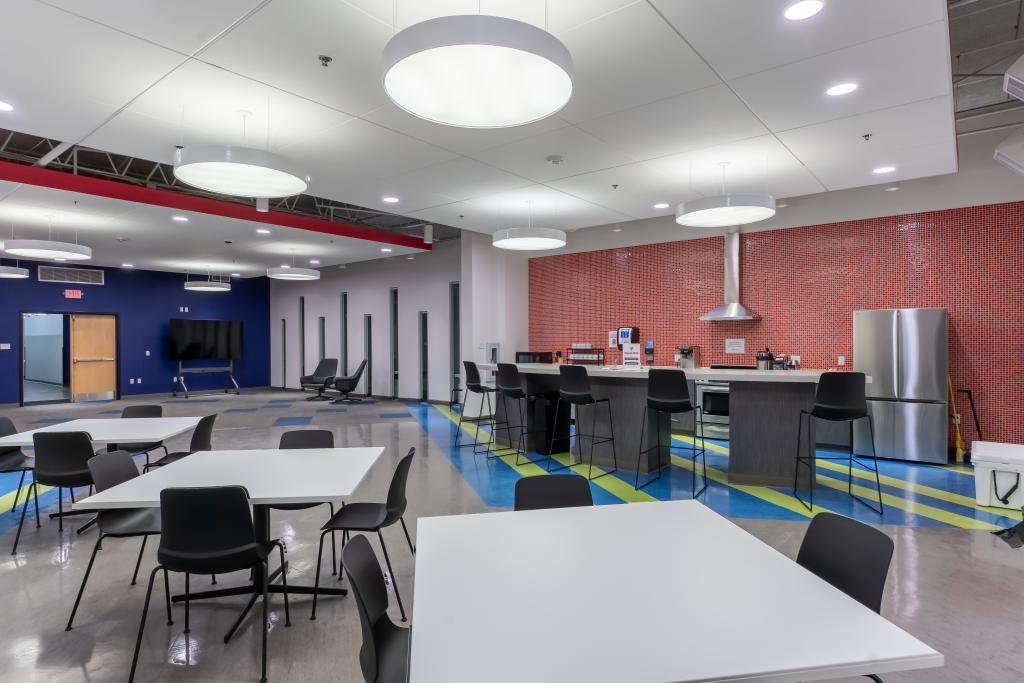
The kitchen and event space in Elevator’s new St. Louis location, which opened March 1, 2026. (Josh Peterson)
Elevator has 16 employees, and a majority of their customers are e-commerce businesses, and a variety of small businesses.
“One of the biggest takeaways is that it ended up being more diverse than we even originally thought,” Lerda said. “We’re really happy about that because it shows how adaptable and flexible our spaces can be and our model can be. And it can be helpful or useful for a lot of people that maybe engage in business services and maybe they’re trying to get out of their house and this would be the first space outside of the home.”
“You don’t need to come to us proving that you are a solid business,” he said. “Even if you’re just trying to explore an idea and you want to rent a space for a few months to try it out, we are in the right place to do that. Some businesses also come to us because maybe they’re looking for their permanent space and they’re planning to sign a long-term lease somewhere else. But they need a place to wait or to be flexible in the meantime as they’re growing.”
Stay informed about what’s happening in your community. Your source for stories that inspire — visit HolaNebraska.org for news, culture, and community updates across Nebraska!