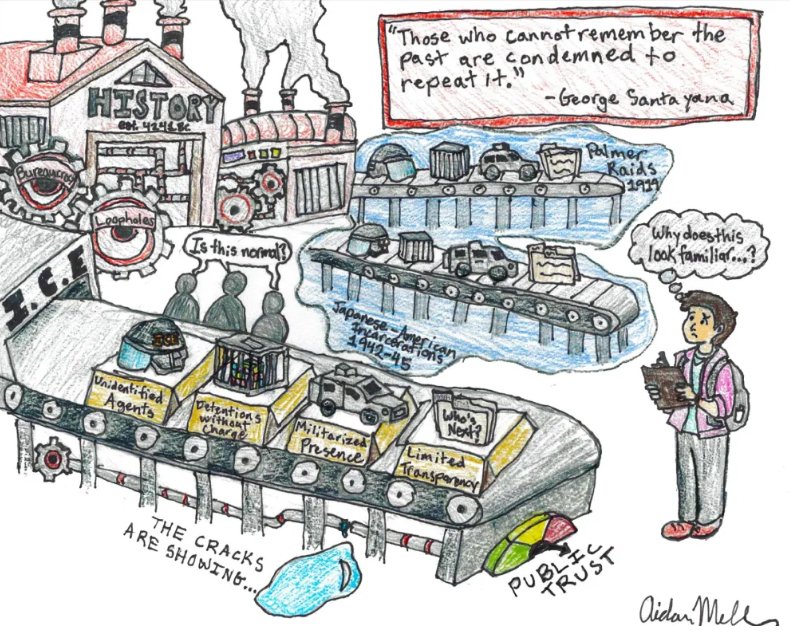
McClaren’s editorial cartoon criticizes ICE actions, comparing them to historical actions by the U.S. government now widely considered oppressive. (Courtesy of Student Press Law Center)
By Macy Byars, Nebraska Public Media
Aidan McClaren came home from work one night with an idea for a political cartoon.
“I sat down and just sketched it out a little bit, and it turned into this factory – like a ‘history’ factory,” said the junior at Gretna East High School.
McClaren had seen many Tik Toks and Instagram posts about Immigration and Customs Enforcement actions in Minneapolis and felt inspired to comment on the situation.
“I was seeing stuff that was comparing the things ICE were doing to the things that have happened in the past with American military operations, and so I just kind of wanted to show that in an editorial cartoon,” McClaren said.
When he made the cartoon in January, McClaren was halfway through his second year writing for Gretna East Media’s student publication – The Wingspan. But at first, he was too afraid to show it to the paper’s staff and carried the cartoon in his backpack for a week.
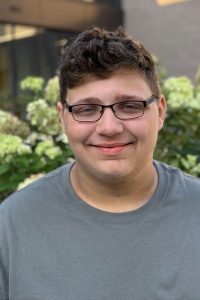
Aidan McClaren
“I felt that people might not agree with it,” McClaren said. “I thought it might not be the kind of thing that we would put in our paper.”
When he did share it with the class, they decided to publish it in The Wingspan in February with the title “ICE’s militaristic operations are history repeating.”
School administrators took it off the website two days later.
“I guess I wasn’t surprised,” McClaren said. “I mean, I knew it was controversial. I knew that people would disagree. But isn’t that the point?”
At first, McClaren “just kind of went with it.” Later, he reached out to the Student Press Law Center through its free legal hotline. SPLC said the best thing McClaren could do was talk to administrators and get a written reason for the removal.
McClaren wrote another article about the removal – an opinion piece about censorship. The school didn’t allow it to publish either.
“And so their solution was, one, we can either publish a cartoon that argues the opposite direction – so like pro-ICE – or we can explain the cartoon for the audience,” McClaren said. “Like, just word-for-word, tell them what it means, tell them how to interpret it – which kind of defeats the point of an editorial cartoon.”
On Monday, the students made a formal appeal to the Gretna Public Schools Board of Education. It asks Gretna school board members to adopt a school press freedom policy, reinstate the cartoon, allow student journalists to report on the removal and end prior review by administration.
Another Wingspan student journalist, junior Nick Mitchell, started a petition after the meeting. It asks for the same actions as the school board appeal.
“My thought is that it’s not, it’s not about the politics of the cartoon,” Mitchell said. “I think that, I think that it was wrong for it to be taken down, and that there should be policies governing what it is the school is allowed to do what we’re allowed to do.”
As of publishing, the petition has just over 400 signatures.
Gretna’s school board has not yet approved or denied the appeal. In a statement to Nebraska Public Media News, Gretna Public Schools administration stated the district has always supported student journalists and offered solutions, but the paper needs to provide “balanced” coverage, “particularly in today’s divided political climate.”
“We remain committed to helping our students understand and engage in responsible reporting and the important role journalism plays in our community and society as a whole. At the same time, as a public school district, we have an obligation to ensure that student publications do not include content likely to cause a substantial disruption to the school environment,” the statement read.
Public schools are a gray area for free speech rights
Student Press Law Center staff attorney Jonathan Gaston-Falk is helping the Gretna East students determine how to move forward.
“Whenever a student journalist is censored for their work in school, there are lawful reasons to censor that work,” Gaston-Falk said. “When we have – especially in public schools like this – we have unprotected areas of speech where, regardless of the medium – including student journalism – we’re not going to be able to stand behind the First Amendment to have that be protected.”
Most student journalists are subject to the 1988 Supreme Court decision Hazelwood v. Kuhlmeier. In the case, journalism students in Missouri wrote about teen pregnancy and the impacts of divorce on their peers. The principal, who deemed the content inappropriate, pulled the stories before the paper was published.
After two conflicting rulings in lower courts, the Supreme Court held that schools had the right to limit speech that conflicts with educational goals or the “the shared values of a civilized social order.”
“It’s easier to censor those student works simply because they are associated with that school,” Gaston-Falk said.
But Gaston-Falk said that case did provide some protections for student journalists.
“They, if they are going to be censored, are at the very least entitled to a reason – that legitimate pedagogical purpose – for that censorship,” Gaston-Falk said.
Not every student gets that reason, Gaston-Falk said, which would be a violation of the federal right afforded to students.
Nebraska has no other existing speech protections for student journalists. Since 1977, eighteen states have adopted “New Voices” laws, which protect student journalists and journalism teachers from censorship.
“Typically, those laws will afford these students the right to have a district policy – a school district policy harmonizing with that state law,” Gaston-Falk said. “But also, those New Voices laws build in employment protections for those trusted adults – those beloved media advisors – because district administrators are able to punish or put some pressure on those advisors. That’s a means of indirect censorship for the students. That’s a chilling effect.”
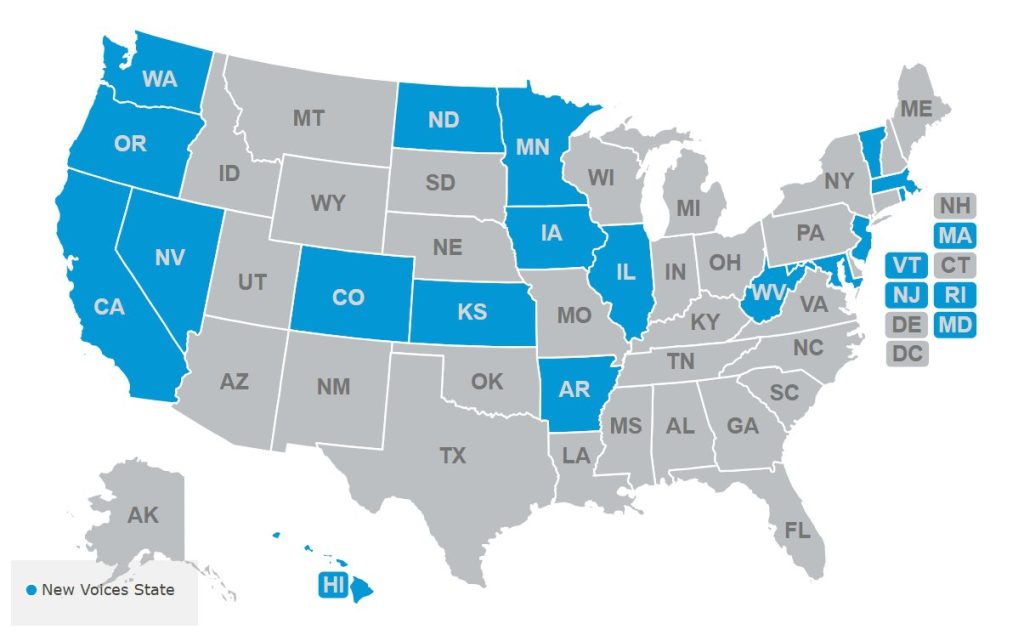
Eighteen states have passed laws protecting speech by student journalists. Six other states have introduced bills in the 2026 legislative season. (Screenshot from Student Press Law Center)
Bills offering further protections to student journalists have been introduced in Nebraska before, but none have passed.
As an alternative to state legislation, school boards can adopt policies that limit censorship of student journalists’ work. At the SPLC’s recommendation, a board policy is one of the Gretna East students’ requests.
Gaston-Falk wrote a letter of support to the Gretna Public Schools Board of Education on Monday, saying that adopting a policy would resolve the dispute and show students the district trusts them to participate in democracy.
“Student journalism is not merely an extracurricular activity; it is a practical application of critical thinking, ethical reasoning, and civic engagement,” Gaston-Falk wrote. “When students are allowed to report on real issues, make editorial decisions, and – when necessary – challenge authority, they are not undermining the educational mission. They are fulfilling it.”
McClaren hopes the school board will adopt the new policy.
“I really didn’t even care about the cartoon being reinstated,” McClaren said. “I just kind of just wanted the policies to be implemented at the board level to protect the future journalists when this happens again. Because it will, it always does.”
Stay informed about what’s happening in your community. Your source for stories that inspire — visit HolaNebraska.org for news, culture, and community updates across Nebraska!